


The walk to Chimi Lhakhang takes you through rice paddies rather than crowds – a flat, easy half hour from the road, past farmhouses where phalluses are painted on exterior walls in cheerful, unembarrassed color, some winged, some dripping ribbons, most rendered with more enthusiasm than anatomical accuracy. Nobody in the Punakha valley finds this remarkable. Ask a shopkeeper why, and she’ll shrug and mention Drukpa Kunley, as though invoking a favorite uncle rather than a fifteenth-century Buddhist saint.
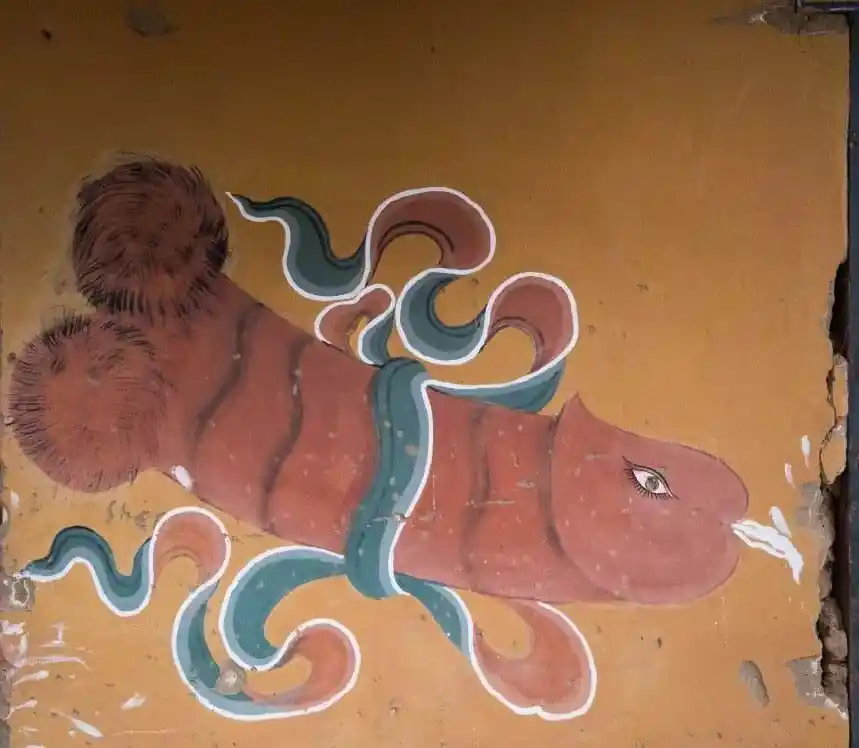
Kunley remembered across Bhutan as the “Divine Madman” remains one of the more startling figures in Himalayan Buddhism: a wandering yogi who taught through outrage rather than sermon, using sex, alcohol, and crude humor to jolt his followers out of hypocrisy and toward enlightenment. Legend holds that he subdued a demoness troubling the Punakha valley by striking her with his “flaming thunderbolt of wisdom” a euphemism Bhutanese folklore has never bothered updating and that the small, white-domed temple built afterward, Chimi Lhakhang, still carries his blessing for fertility.
The temple itself is modest, almost anticlimactic after the build-up: a single-story structure completed in 1499, its interior dim and fragrant with butter lamps, presided over by a monk who will, with practiced solemnity, bless visitors by tapping their heads with a wooden phallus mounted on an ivory handle reportedly the saint’s own, or a relic closely associated with him. Childless couples travel from across Bhutan and increasingly from abroad specifically for this, and the temple’s walls are hung with photographs sent back by grateful parents, a wall of evidence the monks regard as simple fact rather than superstition.

What makes the story land, rather than merely amuse, is the seriousness underneath the absurdity. Drukpa Kunley’s teaching was a genuine critique of religious pretension of monks who performed piety without embodying it and his crude methods were, by his own account, deliberate provocations meant to strip away spiritual vanity. Bhutanese Buddhism has never fully domesticated him into a saint of quiet reverence; the phalluses on the farmhouse walls function as both protection against evil spirits and a wink at anyone tempted to take religion too solemnly.
Walking back through the paddies afterward, past children herding cows and women transplanting rice seedlings ankle-deep in mud, the whole visit resolves into something unexpectedly tender: a culture confident enough in its faith to let a saint be ridiculous, generous enough to bless strangers who show up hoping for a child, and irreverent enough to paint the evidence on every wall in the valley without a trace of self-consciousness.


