


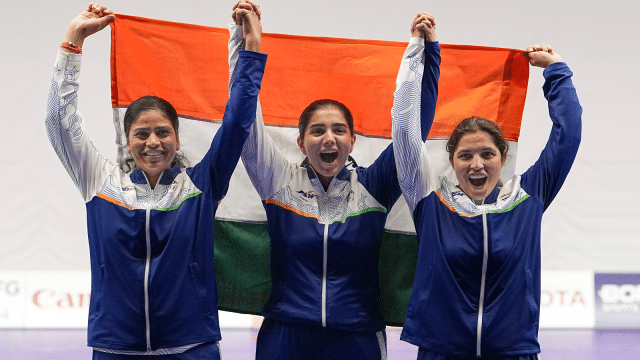
India’s fourth place at Aichi-Nagoya is not a trophy for us to applaud from the stands. It is a map of what a neighbour with money, depth and a coaching system can now do, and of the few doors that map leaves open for a country of our size.
India closed the Asian Games 2026 in Aichi-Nagoya on 4 October in fourth place, with 85 medals: 21 gold, 27 silver and 37 bronze. China was unreachable, on 169 gold and 341 medals in all. Japan and South Korea took second and third. The haul is India’s second-best at the Games, behind the 106 medals and 28 gold of Hangzhou, and well clear of Guangzhou, Incheon and Jakarta. The golds were spread rather than concentrated: archery five, shooting and boxing three each, wrestling, kabaddi, hockey and cricket two each, with single golds in athletics and golf. Athletics supplied the volume, 24 medals, most of them silver and bronze. That is the shape of a system that can now fill finals, not merely enter them.
Bhutan should read that table as a neighbour, not as a spectator. We will not match 85 medals. We should not try. What we can take is method, and a short list of sports in which Indian expertise is already close enough to use.
Archery is the obvious place to start, and not only because it is ours. India’s five golds in Aichi-Nagoya came from a compound and recurve pipeline that now produces both team titles and individual finalists. Our own national side already treats Indian ranges as a training ground: the Bhutan Archery Federation sent its Asia Cup squad to a camp at the Dola and Rahul Banerjee Sports Foundation in Kolkata before Bangkok. That should stop being an occasional arrangement and become a standing one. A small annual quota of Bhutanese recurve and compound archers, with their coaches, at a Sports Authority of India centre or a private high-performance base, tied to a return obligation to the national programme, would cost little and compound. Traditional archery remains our social sport. Olympic-discipline archery is where a medal at a South Asian or Asian event is actually plausible. The two should not be confused, and the second should not be left to goodwill.
Shooting is the second opening. India took 15 medals in the sport at these Games, including an individual trap gold that ended a 48-year wait and a mixed trap gold at an Asian-record score. We do not have that depth. We do have a reason to build a narrow version of it. The Rama Centre of Excellence for Cricket and Shooting, whose groundbreaking India and Bhutan marked together, is the right shell if it is finished as a working range rather than a plaque. Air rifle and air pistol need covered lanes, a certified armourer, and one imported coach on a two-year contract. They do not need a stadium. A centre that can host a South Asian ranking event would change the arithmetic for our athletes more than another multi-purpose hall.
The halls matter anyway, and India is already paying for some of them. The Tsirang Multi-Sports Hall, opened in 2025 as an India-Bhutan friendship project, sits inside a wider pattern: New Delhi’s support for the 13th Five-Year Plan includes community infrastructure, and the 2024 memorandum on sports and youth was meant to turn that from buildings into programmes. Buildings without coaches are warehouses. The memorandum should be used for what it was written for. A rotating attachment of Indian athletics, archery and strength coaches to the Bhutan Olympic Committee, and a matching attachment of our physical-education teachers to a Khelo India district centre, is more useful than another foundation stone. High altitude is our unbought advantage. Indian distance runners are still learning what our schoolchildren live with. A joint altitude camp in Bumthang or Paro, with Indian middle-distance squads paying their way and our juniors training beside them, is a bargain on both sides.
Cricket and football should be kept in proportion. India won both cricket golds in Aichi-Nagoya, men and women. That confirms a depth we cannot replicate and should not chase as a medal strategy. Cricket in Bhutan is a participation sport and a link to the region. A tied arrangement with a state association for umpiring courses and age-group tours is enough. Football is where school competition already exists. Indian academy methods, not Indian league contracts, are the relevant import: small-sided games, a coaching licence ladder, and a girls’ league that is not an afterthought.
We do not need a new doctrine. We need to spend the sports memorandum, finish the shooting lanes at the Rama centre, and turn the Kolkata archery camp into a calendar rather than a press note. India has just shown, again, that a continental medal table is built in ranges and academies years before it is built in a stadium. We are close enough to borrow the method. We are small enough that borrowing it well would show.


