



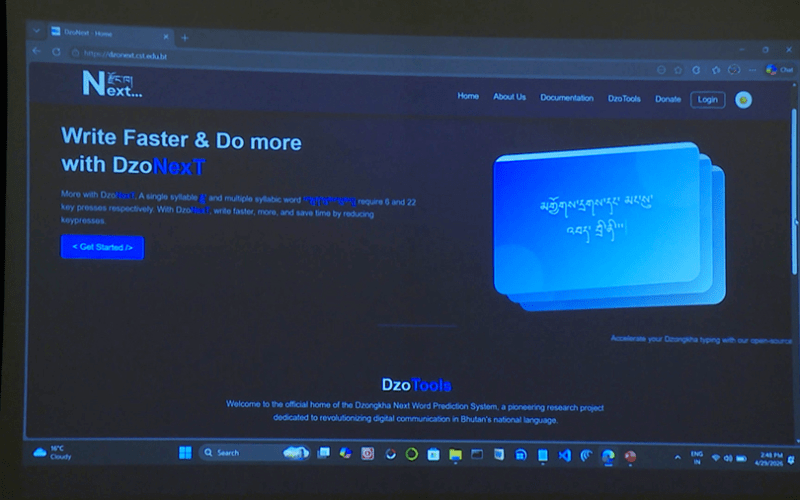
In a significant leap for Bhutan’s digital landscape, the College of Science and Technology (CST) officially launched Dzongkha Next, an innovative predictive text platform designed to make typing in the national language faster, more accurate, and more accessible.
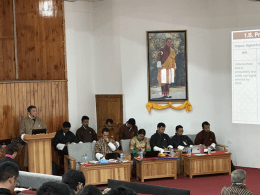
The unveiling took place during the 4th International Conference on Science, Engineering and Technology (ICSET) 2026 in Thimphu, marking a milestone in the intersection of linguistic heritage and modern technology.
“When you type in Dzongkha, it requires many key presses. We wanted to make writing faster,” explained Karma Wangchuk, a lecturer at CST’s Computing Technology Department.
Bridging the Digital Divide
For years, digital communication in Dzongkha has been hampered by the complexity of its script, which often requires multiple keystrokes for a single character. Dzongkha Next solves this by functioning similarly to modern auto-correct and predictive text engines found in English-language smartphones.
The system allows users to type an initial syllable, prompting the AI to suggest likely completions. For instance, typing the syllable “lop” might prompt suggestions like “pen” (teacher), “dra” (student), or “khang” (school). Users simply tap the correct prediction and continue, significantly reducing the physical effort of typing.
A Multimillion-Ngultrum Investment
The journey to launch began in 2020. Over six years of research and groundwork, the project utilized a budget of approximately Nu 12.3 million. A critical factor in the project’s success was the acquisition of high-end computing systems, which the college previously lacked.
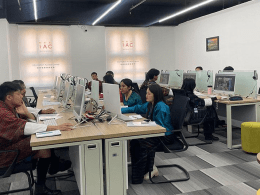
“In the past, our students and staff could not carry out this kind of work because we lacked the necessary computing capacity,” said Cheki Dorji, President of CST. “With our new high-end system, our research team has been able to move this project to a highly advanced stage.”
Accuracy and Collaboration
To ensure the tool is linguistically sound, the model was trained on a massive dataset of over 900,000 Dzongkha texts. These were meticulously reviewed in consultation with the Department of Culture and Dzongkha Development to ensure the predictions adhere to formal grammar and modern usage.
The project has also garnered praise from the international community and local industry:
• International Recognition: Mike Henry from the Shibaura Institute of Technology in Japan expressed his admiration, noting, “It’s very inspiring to see such excellent work being done by the students here… I would love to bring my own students here in the future.”
• Industry Support: Lok Bahadur Ghalley, General Manager with CDCL, emphasized the importance of turning academic theory into real-life practice, noting that such innovations are vital for the country’s professional sectors.
The Future of the National Language
As Bhutanese citizens increasingly move their daily interactions to digital platforms, tools like Dzongkha Next are seen as essential for keeping the national language vibrant in the 21st century.
The developers at CST have stated that today’s launch is just the beginning. Plans are already underway to further upgrade the servers and refine the underlying algorithms, ensuring that Dzongkha typing remains seamless as the user base grows.