


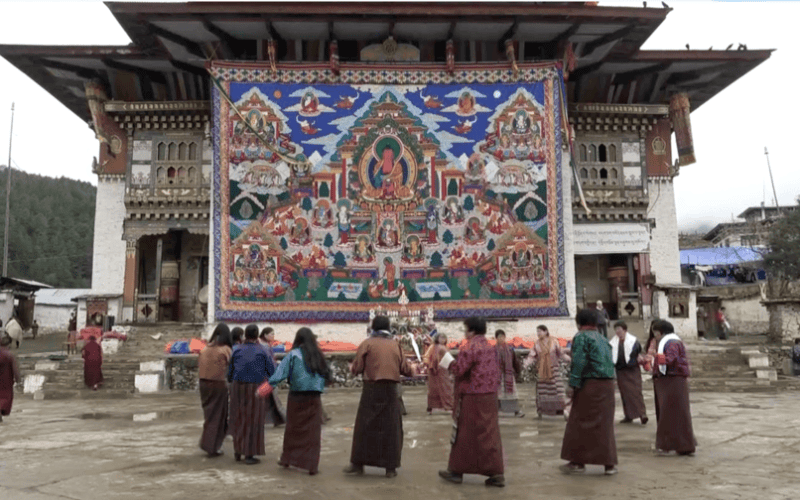
In the quiet highlands of Bumthang, the rhythmic clash of cymbals and the deep beat of drums still resonate across Ura valley each spring. Villagers gather at the centuries-old Lhakhang to celebrate Ura Yakchoe, a sacred four-day festival dedicated to Guru Padmasambhava. Yet behind the vibrant mask dances and colourful folk performances lies a growing concern among residents — the gradual disappearance of the community that has sustained the tradition for generations.
Held annually on the 12th day of the third Bhutanese lunar month, Ura Yakchoe is regarded as one of Bumthang’s most revered spiritual and cultural festivals. Believed to have originated nearly 1,500 years ago, the festival continues to draw hundreds of devotees and visitors, including international tourists eager to witness Bhutan’s living heritage.
However, rural-urban migration is beginning to cast a shadow over the celebrations.
Although Ura chiwog is home to around 60 households with an estimated population of more than 1,200 people, only slightly more than half of the residents remain in the village today. Many younger villagers have moved to urban centres in search of education, employment, and improved opportunities, leaving behind an ageing population struggling to preserve age-old traditions.
Residents say the impact is becoming increasingly visible during the festival itself.
“Each one of us takes responsibility for performing the folk dances, mask dances, and rituals,” said resident Karma Ugyen. “But the courtyard often feels empty because there are fewer spectators and participants than before.”
Today, most of those attending the festival are elderly residents, women, and children, while only a limited number of active performers continue to carry the burden of maintaining the elaborate ceremonies.
Despite these challenges, the community remains determined to keep Ura Yakchoe alive. Organisers and local scholars continue to educate visitors about the spiritual significance and cultural history behind the festival’s rituals and sacred relics.
Among the most revered objects displayed during the festival is a silver statue of Buddha Vajrapani. According to Karma Phuntsho, a scholar from Ura, the relic carries deep spiritual symbolism linked to ancient beliefs surrounding healing and protection.
“It is believed to be connected to the subterranean world of serpents, or Nagas,” he explained. “Leprosy was once thought to be a disease spread by the Nagas, and Vajrapani, manifested in this form, was believed to have the power to control such epidemics.”
The festival remains an important cultural attraction for Bhutan’s tourism industry. Every year, around 500 international tourists travel to Ura to witness the celebrations, contributing to the local economy and helping sustain the tradition.
According to residents, the Department of Tourism considers Ura Yakchoe among the country’s top five tourist-attracting festivals.
“Tourists have been visiting our festival for many years because the dates are communicated to them well in advance,” said resident Tshewang Tashi. “Their presence benefits the community greatly.”
The festival concludes with one of its most sacred moments — the unfurling of the Dechen Zhingdup Thongdrel and the public blessing ceremony involving the treasured Vajrapani relic. Hundreds of devotees from neighbouring communities gather each year to receive blessings believed to bring spiritual merit and protection.
For many in Ura, the festival represents far more than an annual religious gathering. It stands as a symbol of identity, continuity, and the enduring importance of preserving Bhutan’s living traditions amid rapid social change.
As migration steadily reshapes rural communities across the country, residents fear that without renewed efforts to sustain village life, treasured festivals like Ura Yakchoe could one day lose the very community spirit that has kept them alive for centuries.


