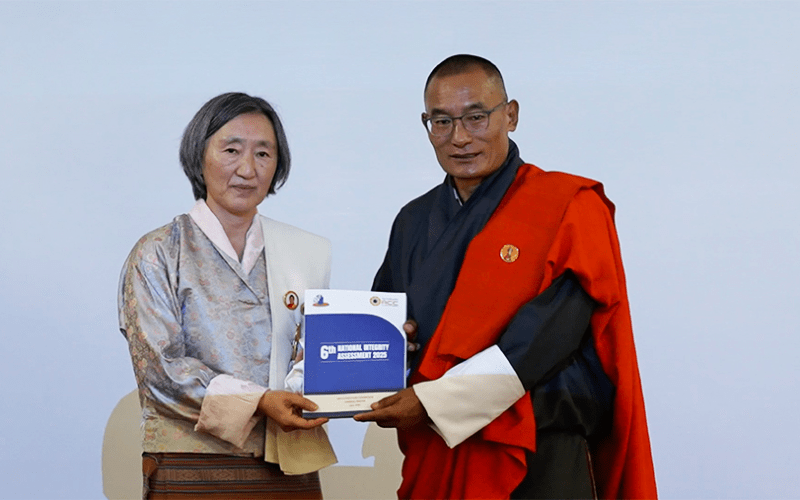
Bhutan’s public institutions continue to enjoy a strong reputation for integrity, with incidents of bribery remaining exceptionally rare. Yet, while traditional forms of corruption appear to be firmly under control, a new challenge is emerging—public confidence in the fairness of decision-making.
These are among the key findings of the National Integrity Assessment (NIA) 2025, which reveals that concerns over favouritism, nepotism and the influence of personal relationships are increasingly shaping public perceptions of integrity.
The assessment shows Bhutan’s overall National Integrity Score has improved from 8.01 in 2022 to 8.16 in 2025, maintaining the country in the ‘Good’ category. The findings suggest that most citizens continue to experience government services as transparent, efficient and largely free from corruption.
Interestingly, members of the public expressed greater confidence in the integrity of public institutions than government officials themselves. The assessment recorded an external integrity score of 8.57, compared to an internal integrity score of 7.98, resulting in an overall public sector integrity score of 8.41, which falls under the ‘Very Good’ category.
Perhaps the most encouraging finding is the continued absence of widespread bribery. The report awarded Bhutan’s Experienced Corruption Index an ‘Outstanding’ rating, reflecting that very few citizens reported paying bribes or making illegal payments to obtain government services.
However, the assessment cautions that integrity challenges are evolving rather than disappearing.
Instead of cash-for-service transactions, respondents increasingly expressed concern that access, opportunities and decisions may be influenced by personal connections or preferential treatment. While only a small proportion of respondents admitted to giving gifts or informal payments, nearly 40 percent believe corruption has increased over the past five years. According to the report, this perception stems less from direct experiences of corruption and more from doubts about fairness and equal treatment.
Within government agencies, systems and procedures remain generally robust. Nevertheless, the assessment identifies weaknesses in organisational culture that could undermine public trust over time. Among the concerns are inadequate protection for whistleblowers, inconsistent disciplinary measures and questions surrounding ethical leadership.
The report assigns Ethical Leadership a score of 7.62, highlighting issues such as perceived unfairness in human resource decisions, hierarchical pressure on employees and an increase in what respondents described as unreasonable instructions from superiors.
The assessment also examines parliamentary integrity, where direct corruption remains minimal but concerns persist over transparency, accountability and favouritism. It further notes a noticeable gap between public opinion and lawmakers’ own assessment of their performance, with parliamentarians generally giving themselves more favourable ratings than those expressed by citizens.
In light of these findings, the Anti-Corruption Commission says Bhutan’s integrity agenda must now move beyond preventing bribery and focus on strengthening institutional accountability and public trust. The Commission recommends reinforcing whistleblower protection mechanisms, improving grievance redress systems, ensuring consistent disciplinary action, enhancing transparency and expanding digital public services to minimise opportunities for undue influence and preferential treatment.
As Bhutan’s governance landscape evolves, the assessment suggests that the country’s next challenge is not merely keeping corruption low, but ensuring that public institutions are seen to be fair, impartial and accountable in every decision they make.