


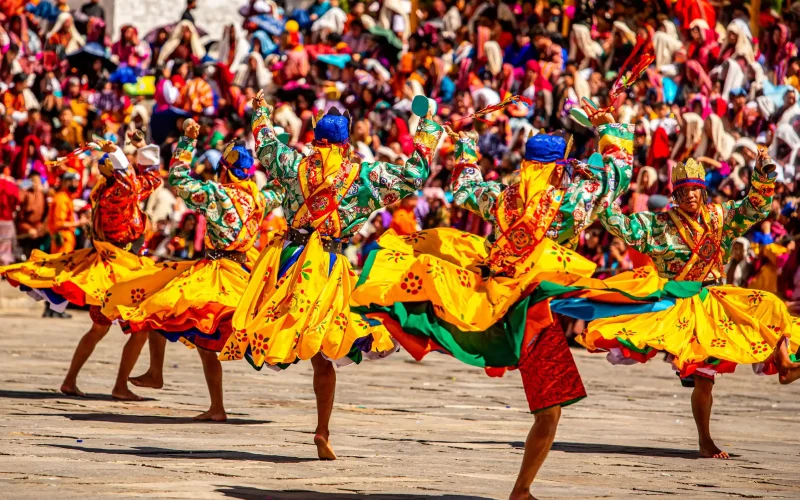
If you want to see Bhutan at its most cinematic, come during festival season. The Tshechu—religious festivals held across the country—are not staged for tourists. They are living rituals, kept vibrant by community devotion and ancestral continuity. To attend one is to witness a culture that has refused to become decorative.
Every region has its Tshechu, but the most accessible for international travelers is Paro Tshechu, held in spring. Arrive early, and you’ll see families already settled in the dzong courtyards like they’re attending a sacred picnic. Women wear shimmering kira, their jewelry catching the light. Men wear gho with crisp white cuffs. Children roam with sweets in hand, their cheeks pink from mountain air. This is not a solemn congregation—it is a social reunion, a religious celebration, a cultural heartbeat.
Then the drums begin.
Mask dances are the center of the Tshechu, performed by monks and trained lay dancers. Their movements are precise but charged with something wild—part theatre, part exorcism. Faces are concealed by magnificent masks: wrathful protectors with flaming eyebrows, skeleton lords of death, animals, demons, deities. The costumes are heavy with brocade, embroidered with symbols that read like esoteric poetry.
To an outsider, the spectacle can feel surreal, even playful—until you realize the dances are not entertainment. They are teachings. Each sequence is a moral instruction: the inevitability of death, the danger of ego, the power of compassion, the protection offered by spiritual practice. In Bhutan, philosophy does not live only in books. It dances.
Between performances, locals mingle. Elders exchange news. Friends introduce visiting relatives. Vendors sell tea, dried snacks, fruit. There is laughter, flirtation, gossip. This is what makes a Tshechu unforgettable: it is not separated from everyday life. Spirituality is not locked away; it is woven into the community’s calendar, like harvest.
And then there is the moment everyone waits for: the unfurling of the thongdrel, a massive sacred scroll painting displayed before dawn on the final day of some festivals. People gather in darkness, wrapped in blankets, breath visible in the cold. When the scroll is revealed, it glows with color—enormous figures of Guru Rinpoche and divine beings looking down with infinite calm. Believers pass before it to receive blessings. Even visitors who do not share the faith often find themselves unexpectedly moved. There is something profoundly human in the act of gathering before daylight to stand in reverence of beauty and meaning.
Plan well. Choose one major Tshechu—Paro, Thimphu, Punakha, or Bumthang—and allow extra days. Festivals are not box-ticking experiences; they are immersion. Also, respect the etiquette: dress modestly, ask before photographing individuals, and keep a quiet reverence even amid celebration.
To attend a Tshechu is to see Bhutan not as a “destination” but as a civilization still practicing itself daily, publicly, joyfully—without apology.


