


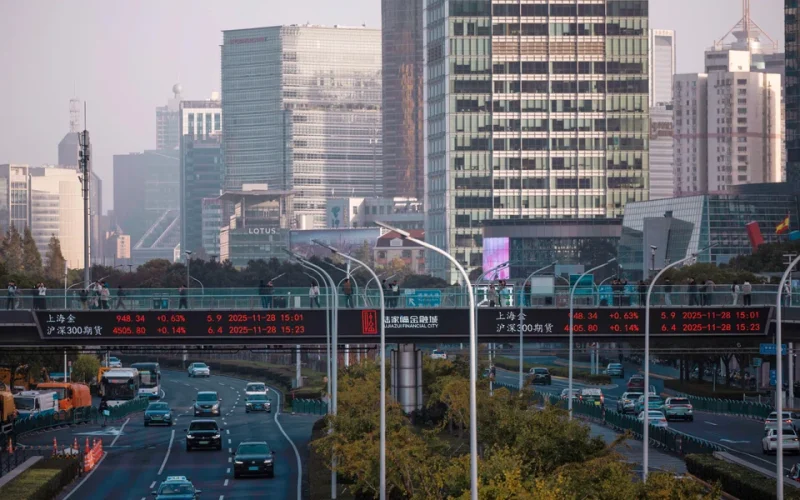
According to a recent WSJ report, China’s long-running growth miracle is now clearly faltering as weakness spreads across consumers, businesses and the property market. The deterioration is broad-based enough that incremental policy tweaks are struggling to restore confidence.
Recent data show China missing the kind of rapid post-pandemic rebound many had expected, with growth held back by persistent structural drags rather than a short cyclical dip. Export performance has offered some support, but it has not compensated for soft domestic demand and a deep property slump.
A central problem is confidence. Households worry about jobs and asset values, while private firms remain cautious after years of regulatory crackdowns and unpredictable policy shifts. The result is an economy that still expands, but at a pace and quality far below what powered China’s rise over the past four decades.
Consumer spending is one of the weakest links. Despite the lifting of pandemic controls, retail sales and services consumption have grown at only a modest pace, well below pre‑2019 trends in real terms. Surveys show Chinese households prefer to save rather than spend, especially on big‑ticket items like cars and apartments.
The property downturn is amplifying this trend. With housing accounting for the bulk of household wealth, falling home prices and stories of unfinished projects have eroded families’ sense of financial security, curbing discretionary spending from restaurants to tourism. Youth unemployment and patchy wage growth further undercut the willingness of younger consumers to take risks or borrow.
For decades, China relied on heavy investment in infrastructure, manufacturing and real estate to drive growth; that model is now under strain. Fixed‑asset investment has stagnated or contracted in key segments, as both private and local-government investors face weaker returns, higher debt burdens and tighter scrutiny.
The slump in property has broken a familiar playbook. In past slowdowns, local governments could ramp up construction and land sales to stabilise activity, but today their balance sheets are constrained by earlier borrowing and collapsing land revenues. At the same time, policy campaigns in sectors from tech to tutoring have chilled corporate risk‑taking, leaving many firms reluctant to commit capital to long‑term projects.
Real estate sits at the heart of China’s current malaise. Developers that binged on leverage under the old “build and sell” model now struggle with debt, unfinished projects and sliding prices, dragging down banks, suppliers and local finances. Nationwide, new housing activity has fallen sharply, while an overhang of vacant and incomplete units weighs on prices and sentiment.
Because land sales once provided a major share of local-government revenue, the property bust also undermines the fiscal capacity of provincial and city authorities. This reduces their ability to fund infrastructure or social programs that could cushion the downturn, reinforcing the broader investment slowdown and the caution of households exposed to the sector.
Structural challenges, limited policy room
Underlying these trends is a deeper transition problem. China is trying to move from an investment- and property-led model towards one driven more by consumption, innovation and services, yet policy and institutions still heavily favour state-led, credit-fuelled projects. Demographic ageing, a shrinking workforce and geopolitical tensions add further headwinds to productivity and external demand.
Authorities have rolled out targeted easing, modest fiscal support and measures to stabilise the housing market, but have largely avoided large-scale direct transfers to households or a decisive clean‑up of bad debt. Without bolder steps to repair balance sheets, boost household incomes and give private firms greater confidence, the deterioration across consumption, investment and real estate is likely to remain a defining feature of China’s economy rather than a passing squall.


